
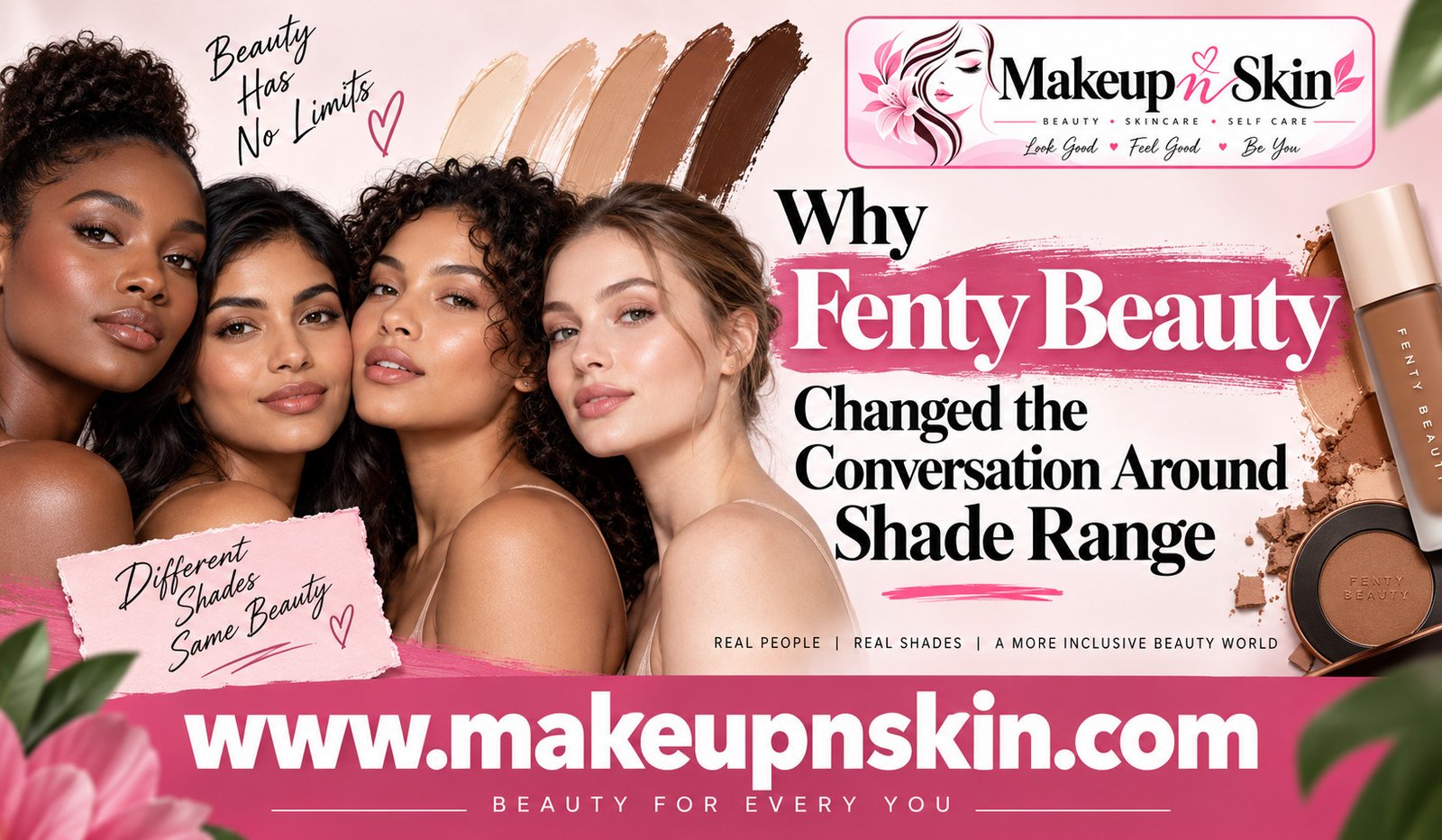
When you shop for foundation, finding your shade should feel simple. You should be able to walk into a store, look at the options, test a few shades, and find something that actually looks like your skin. Yet for years, many shoppers had to mix foundations, settle for a close match, or leave a store without buying anything because their skin tone was not properly represented.
That experience became part of the conversation when Fenty Beauty entered the beauty market. Instead of treating shade variety as a small feature, the brand made complexion inclusivity a central part of its identity. Its approach encouraged you to look at foundation differently: not as a product designed for a limited range of complexions, but as something that should serve people across a much wider spectrum.
Today, Fenty Beauty continues to build on that idea. Its current complexion lineup includes foundations with 50 shades, while other complexion products use different ranges depending on their formulas and purposes.
The Beauty Industry Had a Shade Problem
Before the rise of more inclusive complexion ranges, you could often find dozens of foundation options in a store, but that did not necessarily mean you had dozens of genuinely different skin tones to choose from.
The middle portion of the complexion spectrum was generally easier to shop. If you had a very fair, very deep, or particularly nuanced undertone, your choices could become much narrower.
You might find a foundation that was technically close to your skin tone but noticeably too pink, yellow, orange, grey, or ashy once you applied it. Sometimes you had to buy two shades and mix them together.
That created an important question: Why should you have to modify a product simply because your complexion falls outside the range that a brand considered important?
Fenty Beauty entered this conversation with a different approach.
Fenty Beauty Made Shade Range Part of the Main Story
When Fenty Beauty launched its Pro Filt’r foundation in 2017, its original offering included 40 shades. That number became one of the most talked-about aspects of the launch because the brand did not hide its shade range in the background.
The variety was visible.
Instead of presenting inclusivity as a separate collection or occasional expansion, Fenty Beauty made complexion diversity part of the product’s identity.
That distinction mattered because you were not simply being offered another foundation. You were being shown that a beauty company expected customers with different complexions to shop for the same product.
Over time, the Pro Filt’r range was refined and expanded. Fenty Beauty’s current Pro Filt’r Soft Matte Longwear Foundation is listed in 50 shades, and the brand says its updated range was developed using consumer testing and research, including work on undertones.
Shade Range Became a Measure of Representation
One of the biggest changes Fenty Beauty helped bring to beauty conversations was the idea that shade range could be discussed openly.
Previously, you might have focused mainly on coverage, finish, staying power, or price when comparing foundations. After the rise of more inclusive brands, shade availability became another important part of the discussion.
You could ask:
- How many shades does the brand offer?
- Are the shades spread across the complexion spectrum?
- Are there meaningful undertone differences?
- Can you find a match without mixing products?
- Are deeper shades treated as an afterthought?
- Are very fair shades equally well developed?
Those questions changed how you evaluate complexion makeup.
A large number of shades alone does not guarantee a perfect match. You still need sensible undertones, pigmentation, formulation, and accurate shade descriptions. But Fenty Beauty helped make the breadth of a complexion range something customers could actively examine.
It Was About More Than Counting Bottles
It would be easy to reduce the Fenty Beauty story to one number: 40 shades, then 50.
But the bigger change was cultural.
A shade range works only when the individual shades are useful. Two foundations can both advertise 40 shades while offering very different experiences. One may have large gaps between tones, while another may provide smaller transitions and more nuanced undertones.
Fenty Beauty’s later Pro Filt’r refinements demonstrate this point. The company says it introduced nine new shades to provide a wider range of undertones, rather than simply adding numbers to the collection.
That gives you a more useful way to think about inclusivity. It is not simply about how many bottles sit on the shelf. It is about how thoughtfully those bottles represent real people.
The Consumer Became Part of the Conversation
Another important shift was the relationship between customers and beauty brands.
You no longer had to quietly accept that your shade was unavailable. Social media gave shoppers a powerful way to discuss shade matches, swatches, undertones, and gaps in product ranges.
Fenty Beauty became part of this broader customer-driven beauty culture.
When you saw people sharing their foundation matches online, you could compare your complexion with theirs. You could watch application videos, examine swatches, and learn how different undertones behaved in different lighting.
This made shade selection more transparent.
It also gave customers a stronger voice. If a shade was missing, people could talk about it publicly. If a formula oxidized or looked different from the online representation, customers could share that experience.
The beauty industry therefore became more accountable to the people actually buying the products.
Other Brands Had to Pay Attention
Fenty Beauty did not invent the idea of inclusive beauty. Other brands had already offered broad shade ranges, and many makeup companies have long served diverse customers.
However, Fenty Beauty helped push the issue into mainstream beauty conversation at a particularly visible moment.
Once shoppers became more aware of shade inclusivity, a narrow foundation range could become more noticeable.
You could compare brands more critically. If one company offered a wide selection while another concentrated heavily on a small portion of the complexion spectrum, the difference was easier to see.
This helped create pressure across the industry to think more carefully about complexion products.
The conversation also expanded beyond foundation. Concealers, powders, bronzers, contour products, skin tints, and other complexion categories increasingly became part of discussions about who was being represented.
Inclusivity Became Part of Brand Identity
Fenty Beauty also showed you that inclusivity could influence the entire personality of a beauty brand.
The idea was not limited to a product description saying “available in many shades.” The brand’s marketing, imagery, campaigns, and product presentation contributed to a broader message about beauty.
That made representation visible.
When customers saw people with different skin tones using the same brand, it became easier to imagine themselves as part of that customer base.
This is especially important in beauty because makeup is personal. You are not simply purchasing a technical product. You are choosing something that interacts directly with your appearance and identity.
Seeing your complexion represented can influence whether a product feels designed for you.
Fenty Beauty Also Shows Why Shade Matching Is Complicated
There is another lesson you can take from the Fenty Beauty story: inclusive shade ranges are not as simple as adding darker and lighter colors.
Your skin has an overall depth, but it also has an undertone. Two people can have similar skin depth and still need different foundations because one has warmer undertones while another has cooler or more neutral undertones.
Your skin can also change with the seasons, sun exposure, skincare routines, and other factors.
That is why Fenty Beauty’s current complexion products include shades described with undertone categories such as neutral, warm, and cool. Its newer Pro Filt’r Fluid Flex foundation is offered in 50 shades and emphasizes more refined undertones.
When you shop for foundation, this means you should look beyond the shade number. A shade that appears correct in a bottle may look different once it dries on your skin.
The Conversation Is Still Evolving
Fenty Beauty changed the expectations surrounding shade range, but the discussion did not end with one brand.
Today, you can expect more questions about representation, undertones, accessibility, product availability, and whether inclusive marketing is supported by genuinely useful products.
The standard has become more demanding.
You may now expect a beauty brand to explain its shades clearly, provide useful swatches, offer matching tools, and make different complexion categories easy to shop.
Fenty Beauty itself continues to evolve its complexion lineup. Its current website lists multiple foundation options, including 50-shade ranges for Pro Filt’r products and a 25-shade range for Eaze Drop Lightweight Blurring Skin Tint.
That variation also reminds you that there is no single formula for inclusivity. Different products can require different shade systems.
What Fenty Beauty’s Legacy Means for You
The most significant change is not simply that you can find more foundation shades today.
It is that you can ask for better representation without treating it as an unreasonable demand.
If you are shopping for makeup, you can expect a brand to consider a broader range of complexions. You can look at undertones instead of accepting a vaguely similar shade. You can compare swatches and reviews before purchasing. Most importantly, you can recognize that your skin tone should not be treated as an unusual exception.
Fenty Beauty helped move shade range from a quiet product detail into a major part of the beauty conversation.
Its impact can be seen in the way you shop, the questions you ask, and the standards you may now expect from complexion products.
Key Takeaways
- Fenty Beauty made complexion inclusivity a highly visible part of its brand identity.
- Its original Pro Filt’r foundation launched with 40 shades in 2017.
- The Pro Filt’r Soft Matte Longwear Foundation is now offered in 50 shades.
- The brand’s approach highlighted the importance of undertones as well as overall skin depth.
- Its influence helped make shade range a major consideration when you compare beauty brands.
- Inclusive beauty is about more than adding shades; formulation, undertones, representation, and accessibility also matter.
Frequently Asked Questions
Why is Fenty Beauty known for its shade range?
Fenty Beauty became widely associated with complexion inclusivity after launching its Pro Filt’r foundation with 40 shades and making shade diversity a central part of its brand identity.
How many shades does Fenty Beauty foundation have?
Fenty Beauty currently lists 50 shades for its Pro Filt’r Soft Matte Longwear Foundation.
Why are undertones important when choosing foundation?
Undertones help you find a foundation that blends naturally with your complexion rather than matching only the general depth of your skin.
Did Fenty Beauty invent inclusive makeup?
No. Other brands had offered diverse complexion products before Fenty Beauty, but Fenty Beauty helped make extensive shade range a highly visible mainstream beauty expectation.
What can you learn from Fenty Beauty when buying foundation?
You can look beyond the number of shades and consider undertones, swatches, formulation, shade availability, and how the product actually looks on your skin.
Conclusion
Fenty Beauty changed the conversation around shade range by making inclusivity impossible to overlook.
When you shop for foundation today, you are more likely to think about whether a brand genuinely represents different complexions rather than simply asking whether it has a foundation.
That is the lasting significance of the Fenty Beauty approach. It helped turn shade range from a technical product detail into a question of representation, customer expectations, and thoughtful product development.
The conversation continues to evolve, but the basic expectation is clearer than before: you should have meaningful options when you look for makeup that matches your skin.